A flatbed carries the whole car off the ground on a flat deck. A wheel-lift raises one axle and rolls the car on its other two wheels. A flatbed is the safer choice for all-wheel drive, low or exotic cars, EVs, and any car that cannot roll. A wheel-lift is quick and fine for many standard front-wheel-drive cars going a short distance. Match the method to the car, because the wrong one can damage a drivetrain.
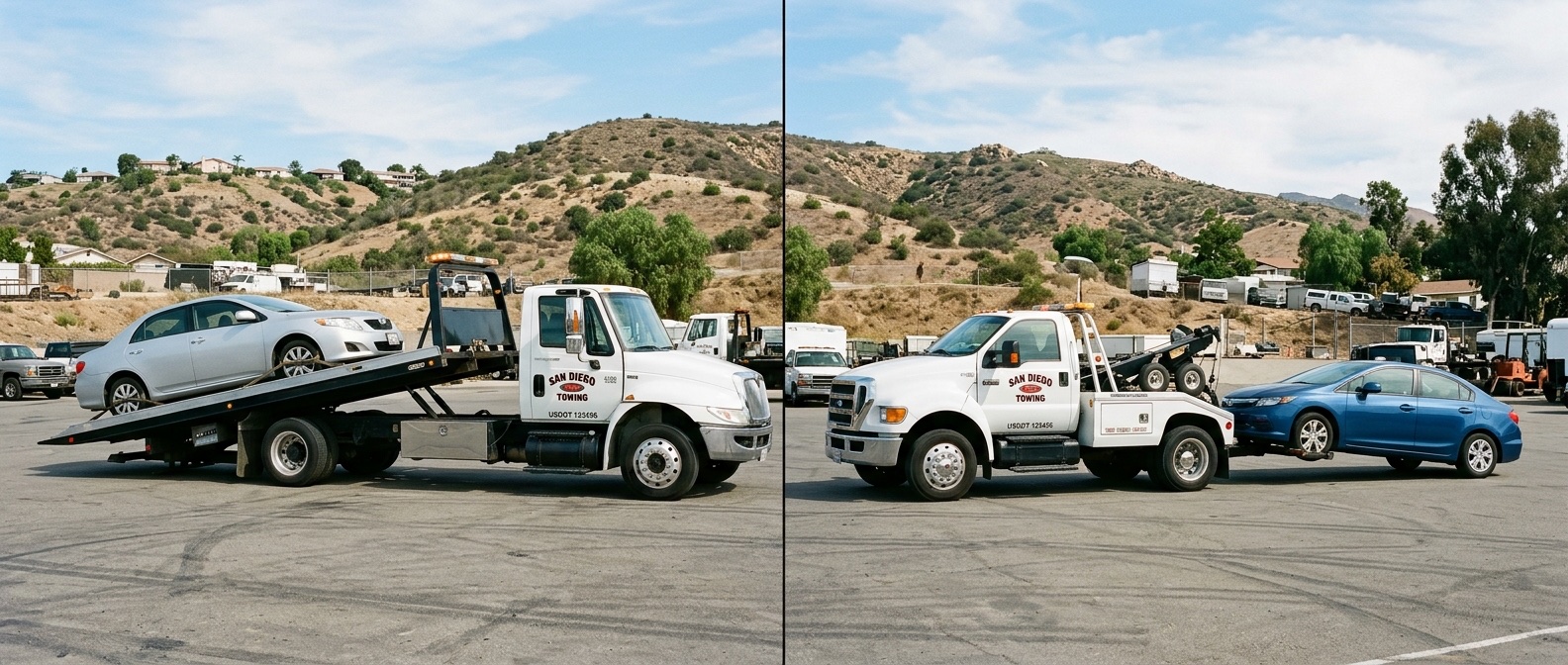
How each method works
A flatbed, sometimes called a rollback, tilts its deck to the ground so the car is winched or driven up, then levels off with the whole car resting on the bed. Nothing touches the road, which is why it is the gentlest way to move a car.
A wheel-lift uses a metal yoke that cradles two of the car’s wheels and lifts that axle. The other two wheels stay on the ground and roll as the truck drives. It is lighter, more maneuverable in tight spots, and faster to hook up, which matters on a narrow Boston street or in a packed garage.
Which your drivetrain needs
The rule that protects your car is simple: the driven wheels should not spin on the road while it is towed. On a wheel-lift, the wheels left on the ground turn.
All-wheel-drive and four-wheel-drive cars generally belong on a flatbed, because towing them with any wheels turning can damage the drivetrain. A rear-wheel-drive car can ride on a wheel-lift with the rear wheels up, or the front wheels up with the driveshaft addressed. A front-wheel-drive car can often ride on a wheel-lift with the front wheels raised. When in doubt, a flatbed is always safe, which is why operators default to it for anything uncertain.
When a Boston job truly needs a flatbed
Some situations leave no choice. A car that will not roll, has a seized wheel, or has crash damage needs a flatbed. A low sports car or a classic that would scrape on a wheel-lift needs a flatbed. Most EVs should ride on a flatbed rather than be dragged on their driven wheels.
Boston adds its own reasons. A car pulled from under a low bridge on Storrow Drive, or one recovered from a flooded underpass near Morrissey Boulevard during a king tide, is usually a flatbed job. Tell dispatch what the car is and what happened, so the right truck comes the first time.
What it costs
A consensual roadside tow is quoted by the operator before dispatch, and the equipment needed is part of that quote. A flatbed job can cost more than a simple wheel-lift because the truck and the loading take more, but for the wrong car a wheel-lift is not a bargain, it is a repair bill.
If the tow is a non-consensual one, the DPU maximums in 220 CMR 272 cap the price regardless of method: up to $132 for the first five miles and up to $35 per day of storage. Method does not raise those caps.
Frequently asked questions
Is a flatbed always better than a wheel-lift? It is always safe, but not always necessary. Many standard front-wheel-drive cars going a short distance are fine on a wheel-lift. A flatbed is the right call for AWD, low, exotic, EV, or non-rolling cars.
Can you tow an all-wheel-drive car with a wheel-lift? It is not recommended. Towing an AWD car with wheels turning can damage the drivetrain, so it generally belongs on a flatbed.
Does my EV need a flatbed? Most EVs should ride on a flatbed rather than be dragged on their driven wheels. Tell dispatch it is an EV so the right truck is sent.
Which is cheaper? A wheel-lift is often quicker and can cost less, but for a car that needs a flatbed, using a wheel-lift risks damage. The operator quotes the correct method before dispatch.
When to call us
Call when your car needs a tow and you want the right truck matched to it. Quick Tow Boston connects drivers with independent operators across Greater Boston, with the price quoted before dispatch. Calls are recorded after a notice. Reach the dispatch line at (857) 858-5057, or read about flatbed towing.