You do not need an AAA membership to get a dead car started. You can jump it yourself with cables and a working car, or call for a pay-per-use jump from a local operator who quotes the price before coming. If the car cranks but will not catch, or the battery is clearly failing, a jump is the fix. If nothing happens at all, it may be more than the battery, and a tow is the safer call.
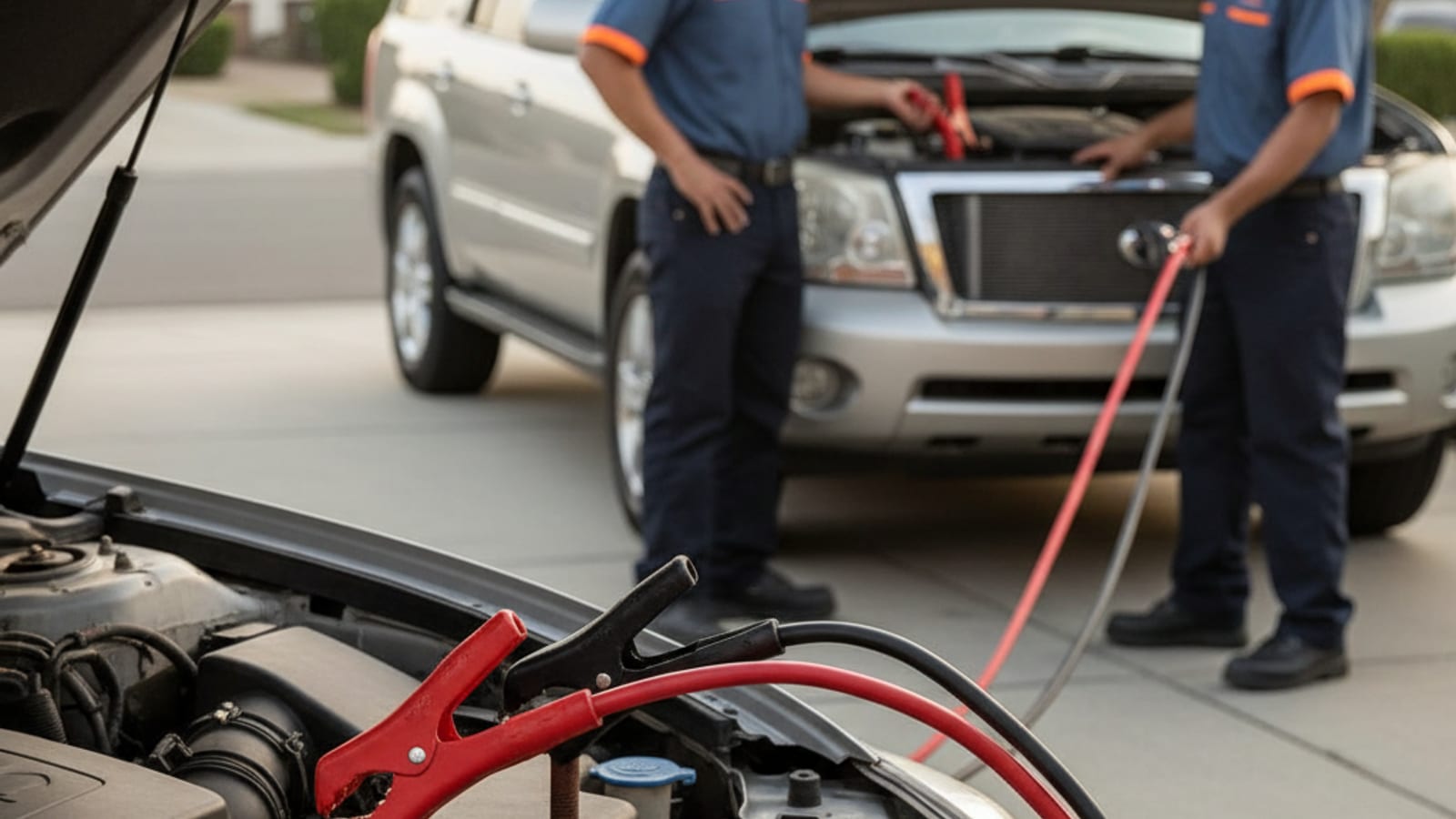
How to jump a car safely
Park the working car close, nose to nose, and turn both cars off. Connect in this order: red clamp to the dead battery’s positive terminal, red clamp to the good battery’s positive terminal, black clamp to the good battery’s negative terminal, and the last black clamp to a bare metal ground on the dead car, away from the battery, not to the dead negative terminal.
Start the working car and let it run a minute, then start the dead car. Once it is running, remove the clamps in reverse order. Then drive for a while so the alternator can recharge the battery, because a short hop will not do it. If the car dies again as soon as you stop, the battery is not holding a charge and needs testing or replacement.
Why summer heat is the real killer
Most people blame Boston winters, but heat is what actually kills batteries. High temperatures speed up the chemical wear inside a battery, so a hot summer week strands more cars than a cold one. The cold morning that finally will not start often finished off a battery the previous summer already weakened.
That means the smart time to test a battery is before a heat wave, not after a breakdown. A battery more than a few years old that struggles on a hot day is warning you.
When a jump is not enough
A jump fixes a dead or weak battery. It does not fix everything that makes a car silent. If turning the key produces nothing, no crank and no lights, or if the car starts and immediately dies, the problem may be the alternator, the starter, or the connections, and repeated jumping will not solve it.
In that case, a tow to a shop is the move. Trying to nurse a car with a charging-system fault through Boston traffic can leave you stranded again in a worse spot, like a live lane on I-93 or the Ted Williams Tunnel, where the State Police have to get involved before any tow.
Getting a jump without a membership
You do not need to join an auto club. A local operator can come out for a pay-per-use jump, and the price is quoted before dispatch based on your location and the job. Give your exact spot, whether it is a street, a garage, or a highway shoulder, so the right help arrives.
Keep a set of jumper cables or a compact jump pack in the car, especially heading into summer. A jump pack lets you start the car yourself without flagging down another driver, which is worth a lot on a quiet street at night.
Frequently asked questions
Can I get a jump start without AAA in Boston? Yes. You can jump the car yourself with cables and another vehicle, or call a local operator for a pay-per-use jump with the price quoted before dispatch.
Why do batteries die more in summer? Heat accelerates the chemical wear inside a battery. Summer heat does the damage, and a cold morning often just exposes a battery that summer already weakened.
When should I tow instead of jump? If the car makes no sound and shows no lights, or starts and immediately dies, the problem may be the alternator or starter. A tow to a shop is safer than repeated jumping.
How do I jump a car safely? Connect positive to positive, then the good battery’s negative, then a bare metal ground on the dead car. Start the good car, then the dead one, and remove the clamps in reverse order.
When to call us
Call when a jump will not hold and the car needs a tow, or when you want a pay-per-use jump from a local operator. Quick Tow Boston connects drivers with independent operators across Greater Boston, with the price quoted before dispatch. Calls are recorded after a notice. Reach the dispatch line at (857) 858-5057, or read about jump start service.