A stuck vehicle in Greater Boston is its own kind of call. The car is not damaged and it does not need a tow, but it cannot drive out under its own power. A snowbank off the Mass Pike, a soft shoulder at a Revere Beach ramp, a soft event lot at Gillette on a rainy night, a median ditch on Route 2 after a rain. The right tool is a winch, and the right operator is one who reads the scene before pulling. Quick Tow Boston connects drivers with independent local operators who run winch-out recovery, and the operator quotes the job before the truck rolls.
What a winch-out is
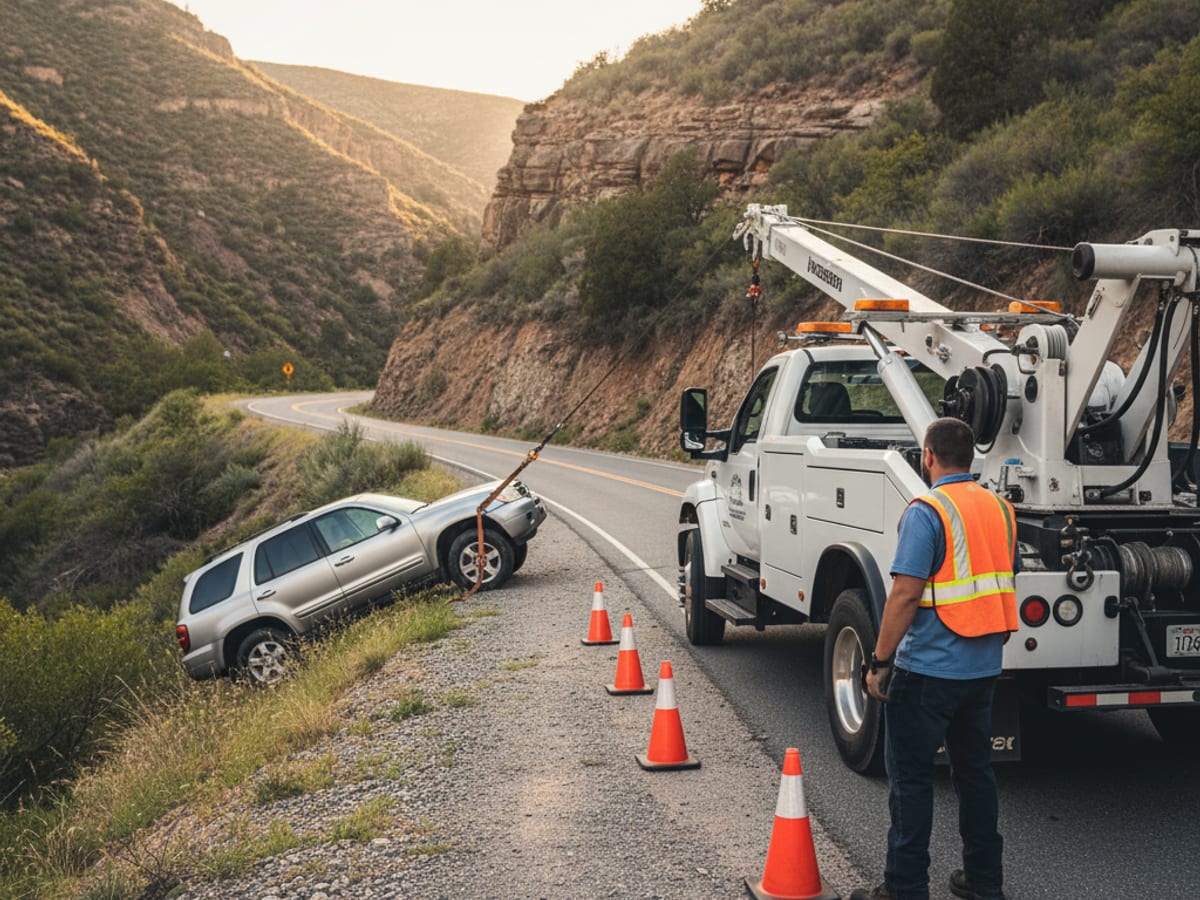
A winch-out pulls a stuck vehicle back onto solid ground with a winch cable or a tow strap, without lifting it. The operator anchors one end of the cable to a fixed object or to the tow truck, and pulls the car straight back. The car’s wheels stay on the ground the whole time.
A winch-out is not a tow. The car is upright, undamaged, and not in a position that needs lifting. It just needs a pull from the right angle by the right equipment.
A good winch-out operator carries:
- A winch cable rated for the vehicle class
- Tow straps rated for the work
- A tree-saver strap for soft anchor points like a sturdy tree or a telephone pole
- A shovel and traction boards for soft ground
- A come-along for tight spaces where the truck cannot get close
Why scene-reading matters
A wrong-angle pull can make a stuck car worse. Pulling a snow-buried car straight up a slope can rip the wheel-well liner out. Pulling a soft-sand car at the wrong angle can dig it in deeper. Pulling a car out of a ditch with the wrong strap can break a tow point.
A good operator reads the scene first and plans the pull. The questions are:
- What is the car stuck in: snow, mud, sand, a ditch, a soft shoulder?
- Which direction is the car facing, and which is the closest solid ground?
- Is there room for the tow truck to anchor the cable from the right angle?
- Are there fixed objects that can be used as anchors?
- Is the car on a slope, and which way does the slope fall?
The plan depends on the answers, and the operator’s quote should reflect it.
Where winch-outs happen in Greater Boston
Five situations generate steady winch-out work in this metro.
Snowbanks on the Mass Pike and I-93. Boston’s snowiest winter on record was 2014-15 at 110.6 inches, with 64.8 inches in February 2015 alone. A nor’easter that drops 18 inches can shove a car off the highway into a snow-filled ditch, and the operator pulls it back with a winch and a tree-saver strap.
Soft event-lot ground. Gillette Stadium, Fenway Park, and TD Garden all draw huge crowds, and the overflow parking is often a grass field or a soft surface that turns to mud after a rain. A car stuck in a soft event lot on a Sunday afternoon is a winch-out with traction boards, not a tow.
Coastal sand on the South Shore and the North Shore. Revere Beach, Lynn Beach, and the Cape beaches pull summer traffic onto sand that is firmer at low tide and softer at high tide. A car stuck at high tide is a time-sensitive recovery.
Median ditches along Route 2 and Route 128. The two highways run through wooded areas with deep medians, and a slide-off in a rainstorm puts the car into a soft-bottom ditch that needs a winch.
Backyard and driveway work. After a snowstorm, a car parked on a snow-covered driveway or a snow-buried curb can be stuck in place without being damaged. A short winch-out pulls it back onto the road.
What an operator needs to know to quote the job
To get a real number before dispatch, give the operator:
- What the car is stuck in: snow, mud, sand, a ditch, a soft shoulder, a snow-covered driveway
- The vehicle type, year, and approximate weight
- Whether the car is upright, on a slope, or on its side
- Whether the wheels spin freely or whether they are buried
- The pickup spot and where the car needs to go
- Whether there is room for a tow truck to anchor from the right angle
- Any hazards: water, traffic, weather
A snow-buried car on the Mass Pike is a different job from a soft-sand car at Revere Beach at high tide. The operator’s quote should reflect that.
What Quick Tow Boston does and does not do
Quick Tow Boston does not own trucks or run a fleet. We connect drivers with independent local operators who run winch-out recovery, and the operator quotes the price before anyone is dispatched. There is no flat rate and no brand price. The Massachusetts DPU maximums under 220 CMR 272.00 cap non-consensual tows at $132 for the first five miles and $4.40 a mile after, with storage at $35 per 24 hours at a fenced-lit lot. A consensual winch-out you arrange yourself is priced by the operator and not capped.
How to keep the bill down
Stop spinning the wheels. Spinning a stuck car digs it in deeper and makes the winch-out harder. Put the car in park, set the parking brake, and call for a winch-out.
Clear the area around the wheels if you can. Shoveling snow out from around a buried tire, or brushing sand off the approach angle, makes the operator’s job shorter and cheaper.
If the car is in a ditch, do not try to drive out. A car in a ditch with the wheels on the wrong side of the slope is a winch-out, not a self-recovery.
Frequently asked questions
Does Quick Tow Boston run its own winch-out trucks? No. We connect drivers with independent local operators who run winch-out recovery, and the operator quotes the price before dispatch.
Is a winch-out a tow? No. A winch-out pulls a stuck vehicle back onto solid ground with a cable or a strap, without lifting it. The car’s wheels stay on the ground the whole time.
Why can’t I just floor it out of the snow? Spinning the wheels digs the car in deeper. The right move is to put the car in park, set the parking brake, and call for a winch-out.
Is there a state cap on a winch-out? The state DPU maximums under 220 CMR 272.00 cap non-consensual tows at $132 for the first five miles and $4.40 a mile after. A consensual winch-out you arrange yourself is priced by the operator and not capped.
When to call us
Call when a vehicle is stuck and needs a real winch and a real operator, not a sedan tow and a guess. Quick Tow Boston connects drivers with independent local operators across Greater Boston, and the operator quotes the price before anyone is dispatched. Calls are recorded after a notice. Reach the dispatch line at (857) 858-5057.