Tesla and EV towing in Greater Boston is its own job, not a sedan tow in a quieter car. Most EVs need all four wheels off the ground, many have a Transport Mode the operator has to enable, and a wheel-lift that grabs the wrong axle on a Tesla can cost the owner a four-figure repair. Quick Tow Boston connects EV drivers with independent local operators who run the right equipment, and the operator quotes the job before the truck rolls.
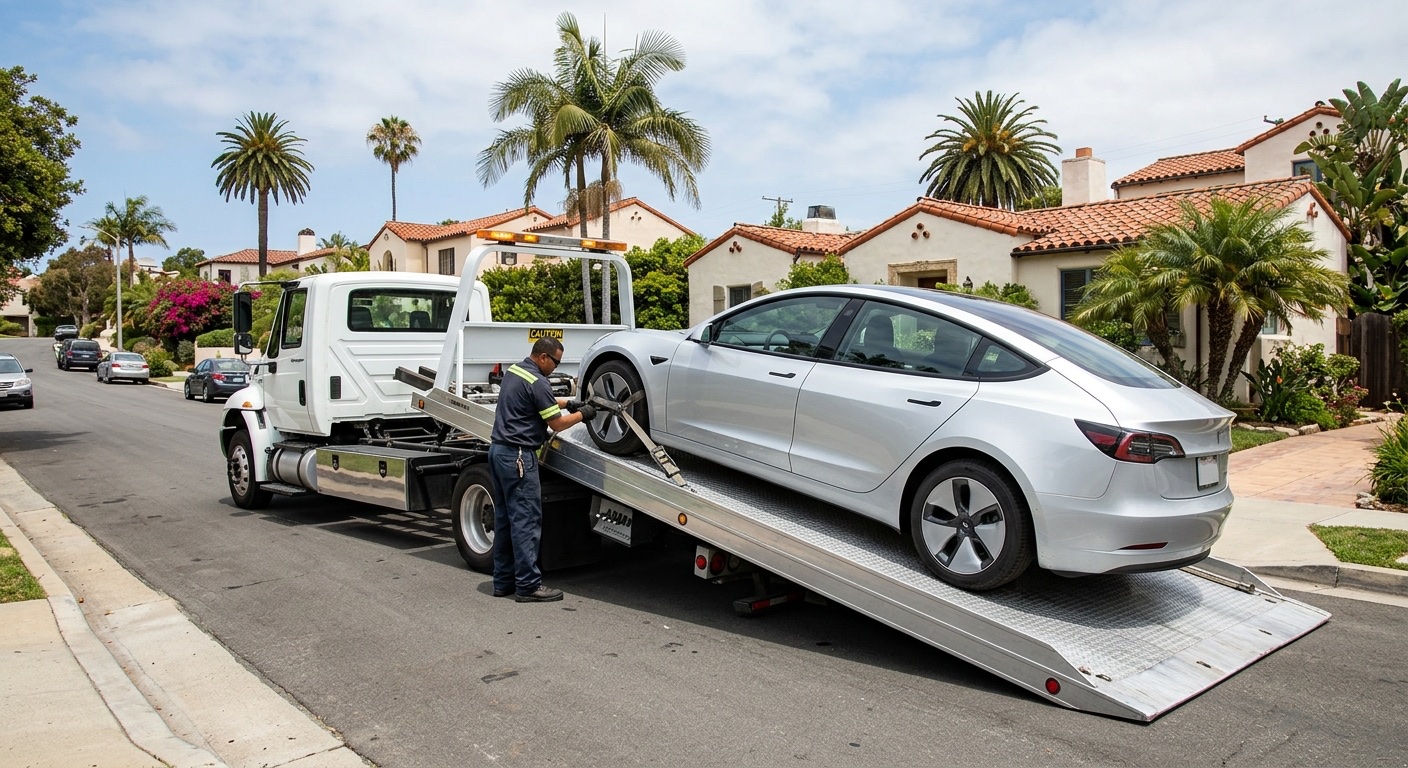
Why a flatbed is the right call for most EVs
The standard advice from every EV manufacturer is to tow with all four wheels off the ground, which means a flatbed. There are two reasons.
First, an EV motor generates power when the wheels turn, and a tow that leaves the wheels on the pavement can back-feed electricity into the motor and damage the inverter or the battery management system. Tesla, Rivian, Ford, Hyundai, and the other major EV makers publish this in the owner’s manual.
Second, an EV battery is heavy and mounted low in the chassis, and the underbody clearance is often less than a comparable gasoline car. A wheel-lift that grabs the front wheels of a Tesla and drags it onto the tow truck can scrape the battery pack on the lift’s approach ramp. The damage is not always visible at the time, and a battery pack repair or replacement runs in the tens of thousands of dollars.
A flatbed with a low deck is the right rig for an EV. The operator drives or winches the car onto the deck and ties it down at the four manufacturer-specified tow points. The car’s wheels never turn.
What Transport Mode is and when it matters
Some EVs have a feature called Transport Mode or a similar setting that disengages the parking brake and the gear lock so the car can roll on its own power at low speed. Tesla has it, as do several other makes. Transport Mode lets the operator move the car around a flat surface without a driver, which is helpful when the car has no power and the parking brake is stuck.
The catch is that Transport Mode lives in the touchscreen, and if the car has no 12-volt power the screen does not turn on. A dead 12-volt battery is a common EV problem, and a stranded EV often needs a 12-volt jump before the screen comes back and Transport Mode can be enabled. The operator’s quote should reflect whether a 12-volt jump is part of the job.
When in doubt, the operator reads the owner’s manual for the right procedure. Many EVs also publish a towing guide on the manufacturer’s site that gives the exact steps.
Where EV breakdowns cluster in Greater Boston
EVs are denser in some parts of the metro than others, and that shapes where the tows show up.
Route 128 and the Mass Pike. The two commuter highways pull EV traffic in and out of the city, and dead 12-volt batteries and out-of-charge EVs show up on the shoulder at rush hour.
The Longwood medical area. Hospital shifts run 24 hours, and EV drivers commuting in and out of the Longwood hospitals see dead batteries in the garages and the surface lots.
The Seaport and the Innovation District. New construction and the tech employers there pull a younger EV crowd, and the parking garages generate dead-battery and lockout calls alongside the highway work.
Alewife and Fresh Pond. One of the most congested stretches of road in Massachusetts, and a place where a stalled EV in the wrong lane gets clipped by a car.
Cambridge and Somerville. The two cities have the highest EV density in the metro and the most residential charging, which means a steady stream of dead-battery calls and the occasional out-of-charge car.
What an operator needs to know to quote the job
To get a real number before dispatch, give the operator:
- The make, model, and year, and whether it is a Tesla, a Ford Mustang Mach-E, a Rivian, a Chevy Bolt, a Hyundai Ioniq, or another EV
- Whether the high-voltage battery is dead or just low
- Whether the 12-volt battery is dead
- Whether the car rolls and steers under its own power
- The pickup spot and where it needs to go
- Any error messages on the screen, if the screen is on
A Tesla with a dead 12-volt in a parking garage is a different job from a Bolt out of charge on the shoulder of I-93. The operator’s quote should reflect that.
What Quick Tow Boston does and does not do
Quick Tow Boston does not own trucks or run a fleet. We connect EV drivers with independent local operators who run low-deck flatbeds and know the EV-specific steps, and the operator quotes the price before anyone is dispatched. There is no flat rate and no brand price. The Massachusetts DPU maximums under 220 CMR 272.00 cap non-consensual tows at $132 for the first five miles and $4.40 a mile after, with storage at $35 per 24 hours at a fenced-lit lot. A consensual EV tow you arrange yourself is priced by the operator and not capped.
How to keep the bill down
Tell the operator up front that it is an EV. The wrong rig is not safe for the car, and a second dispatch costs both ways.
Keep the 12-volt battery healthy. The 12-volt is what powers the screen, the door locks, and the contactor that connects the high-voltage battery. A weak 12-volt battery is the most common reason an EV will not start. Some EV-specific shops and AAA providers can swap the 12-volt on the spot, which avoids a tow altogether.
Pull the parking brake and shut the car off before the tow. A Tesla left in Drive with the parking brake on is a Transport Mode problem the operator has to work around.
Frequently asked questions
Does Quick Tow Boston run EV-specific trucks? No. We connect EV drivers with independent local operators who run low-deck flatbeds, and the operator quotes the price before dispatch.
Why can’t a wheel-lift tow a Tesla? A wheel-lift that grabs the front wheels and drags the car up the approach ramp can scrape the battery pack, which sits low in the chassis. Battery pack repair runs in the tens of thousands of dollars.
What is Transport Mode? Transport Mode is a setting in the touchscreen that disengages the parking brake and gear lock so the car can roll on its own power at low speed. It is needed when the car has no power or the parking brake is stuck.
Is there a state cap on an EV tow? The state DPU maximums under 220 CMR 272.00 cap non-consensual tows at $132 for the first five miles and $4.40 a mile after. A consensual EV tow you arrange yourself is priced by the operator and not capped.
When to call us
Call when an EV is disabled and needs a flatbed and a real operator, not a wheel-lift and a guess. Quick Tow Boston connects EV drivers with independent local operators across Greater Boston, and the operator quotes the price before anyone is dispatched. Calls are recorded after a notice. Reach the dispatch line at (857) 858-5057.